Kaohsiung, Taiwan
Back in Taiwan again. I came back a day earlier than planned for several reasons. First of all, this week was going to be really busy for Mad*ka (as if any week isn't?), and she had to be at work by 10:00 on Monday morning (my flight was at 4:30 P.M.), and I thought it would be good to get out of her hair and cramped apartment to give her a bit of a breather, even if she didn't necessarily need it and seems to appreciate my company. Also the flight on Monday was completely booked, and the flight on Sunday wasn't, and I prefer to avoid any crush of people, but especially in flying. Lastly, I felt my cousin would appreciate my coming back early to help out with the kids.
And it was cold in Japan. So nice to be back in the tropics, short-sleeve shirts and denim jacket. My cousin picked me up from the airport and informed me my uncle was gone on vacation for the week! He went to Cambodia. I think he didn't mention this trip to me on purpose. Partly because he's a bit absent-minded, but also to not have the possibility that I might want to go with him, which I wouldn't have. But he's great, he's in his late 70s but his mind is still in his 20s and he likes having fun without the burden of watching out for a nephew, so god bless him going on the trip without mentioning it to me!
It's good for me, too. After a week of not actively practicing and no sitting, I wanted to come back adamantly insisting on extended sitting each day, hour and a half in the morning and evening, including a 10 minute walking. So with my uncle on vacation, I can use the rooftop shrine room at will, and the roof is perfect for 10 minutes of walking, too.
Now I just have to consider returning to Deer Park.
Tuesday, March 08, 2005

Thursday, March 03, 2005
Nagasaki, Japan
I chose Nagasaki as my other destination in my travels because I've never been here. Never been in this part of Japan, never been to Kyushu. I also wanted to visit a city where there was a definite reason aside from usual touristy stuff, and I thought Nagasaki could be a pilgrimage of human suffering because of the Atomic Bombing. I've already been to Hiroshima in August 1995.
Wow, I love Nagasaki! Kyoto was a bit of a drag in comparison. I wish I knew more about the nooks and crannies of the city and if there are more bohemian quarters, but Nagasaki is already distinguished because of the strong foreign influence on the culture here. There's a heavy Korean and Chinese population due to the proximity to the Asian mainland, and there's also a strong Western influence because for centuries of national isolation, Nagasaki was the only port where foreigners were allowed.
It also feels a little bit like San Francisco, but maybe that's because it rained all day today. But also because there are a lot of hills, they use street cars like the Muni light rail, there is a harbor with waterfront access like the bay, and they're even a building a bridge over the mouth of the harbor like the Golden Gate.
Climbing hills gives panoramic views like San Francisco. You can just make out the bridge building in progress on this foggy, rainy day:

But my main reason for coming to Nagasaki was to visit the Ground Zero memorial and the Nagasaki Atomic Bomb Museum. The convenient circular form around the Ground Zero monument made for good walking, and I ended up walking around and around, albeit slowly, for over 45 minutes.

The museum left a lot to be desired, though. The raw material they had for the museum was good, as was the information, but the multi-media presentation was confusing and distracting and always required multiple viewings for it to sink in. I also thought the layout of the exhibition could have been better, but maybe I'm just griping because I was hungry.
As a pilgrimage, it was really good to come here. It wasn't as intense as when I was in Hiroshima, on the 50th anniversary of that bombing, but the magnitude of what happened here still demanded deep reflection and sadness (and anger, but that's another story).
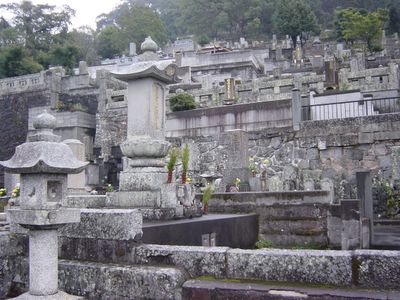
In the afternoon, I went to a section of town called Teramachi (tera=temple, machi=town). It was fantastic, one street lined with Buddhist temples. Apparently the Shogunate at one point issued an order that each sect of Buddhism build a temple on Teramachi in Nagasaki. For Buddhism, Nagasaki clearly outshines poseur Kyoto. Kyoto is just about that pompous Zen aesthetic. The truth about Buddhism in Chinese and Japanese spirituality is that it was most looked upon for funerals. Many times monks bemoaned their duties focusing on performing funerals instead of practicing. In Teramachi, the cemeteries associated with the temples line the mountainside against which Teramachi lies, and they go all the way up the mountain. You see nothing like that in Kyoto.
Like the temples in Kyoto, you don't see a lot happening. You wander in, you wander around, then you wander out. There were two famous temples that are on the tourist maps, and those temples charged admission, and I didn't go to them. All the other temples didn't charge admission, and were basically the same thing.
Temple cemetery lining the mountain side:
I came here knowing nothing about the city except that the second Atomic Bomb was dropped here. Knowing nothing about where to go, what there is to do, or what it's like, and my knowledge only marginally better now, I must say I really do like this city. If I had a choice of all the cities I've visited in Japan, I'd choose to live here.
I chose Nagasaki as my other destination in my travels because I've never been here. Never been in this part of Japan, never been to Kyushu. I also wanted to visit a city where there was a definite reason aside from usual touristy stuff, and I thought Nagasaki could be a pilgrimage of human suffering because of the Atomic Bombing. I've already been to Hiroshima in August 1995.
Wow, I love Nagasaki! Kyoto was a bit of a drag in comparison. I wish I knew more about the nooks and crannies of the city and if there are more bohemian quarters, but Nagasaki is already distinguished because of the strong foreign influence on the culture here. There's a heavy Korean and Chinese population due to the proximity to the Asian mainland, and there's also a strong Western influence because for centuries of national isolation, Nagasaki was the only port where foreigners were allowed.
It also feels a little bit like San Francisco, but maybe that's because it rained all day today. But also because there are a lot of hills, they use street cars like the Muni light rail, there is a harbor with waterfront access like the bay, and they're even a building a bridge over the mouth of the harbor like the Golden Gate.
Climbing hills gives panoramic views like San Francisco. You can just make out the bridge building in progress on this foggy, rainy day:

But my main reason for coming to Nagasaki was to visit the Ground Zero memorial and the Nagasaki Atomic Bomb Museum. The convenient circular form around the Ground Zero monument made for good walking, and I ended up walking around and around, albeit slowly, for over 45 minutes.

The museum left a lot to be desired, though. The raw material they had for the museum was good, as was the information, but the multi-media presentation was confusing and distracting and always required multiple viewings for it to sink in. I also thought the layout of the exhibition could have been better, but maybe I'm just griping because I was hungry.
As a pilgrimage, it was really good to come here. It wasn't as intense as when I was in Hiroshima, on the 50th anniversary of that bombing, but the magnitude of what happened here still demanded deep reflection and sadness (and anger, but that's another story).
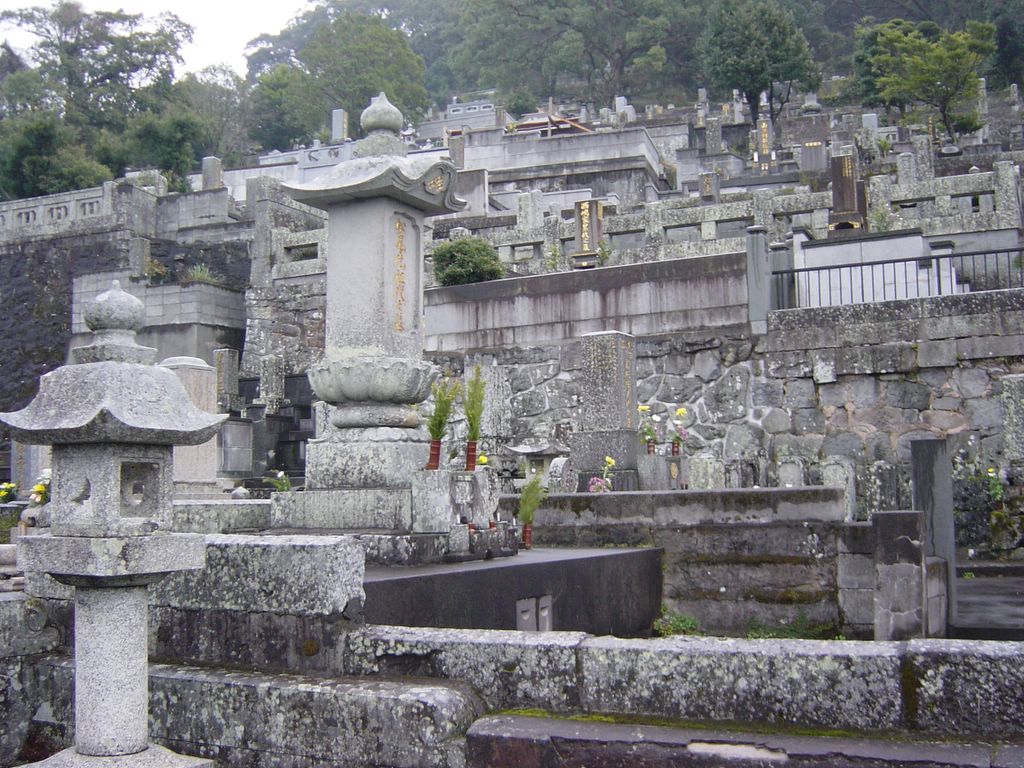
In the afternoon, I went to a section of town called Teramachi (tera=temple, machi=town). It was fantastic, one street lined with Buddhist temples. Apparently the Shogunate at one point issued an order that each sect of Buddhism build a temple on Teramachi in Nagasaki. For Buddhism, Nagasaki clearly outshines poseur Kyoto. Kyoto is just about that pompous Zen aesthetic. The truth about Buddhism in Chinese and Japanese spirituality is that it was most looked upon for funerals. Many times monks bemoaned their duties focusing on performing funerals instead of practicing. In Teramachi, the cemeteries associated with the temples line the mountainside against which Teramachi lies, and they go all the way up the mountain. You see nothing like that in Kyoto.
Like the temples in Kyoto, you don't see a lot happening. You wander in, you wander around, then you wander out. There were two famous temples that are on the tourist maps, and those temples charged admission, and I didn't go to them. All the other temples didn't charge admission, and were basically the same thing.
Temple cemetery lining the mountain side:
I came here knowing nothing about the city except that the second Atomic Bomb was dropped here. Knowing nothing about where to go, what there is to do, or what it's like, and my knowledge only marginally better now, I must say I really do like this city. If I had a choice of all the cities I've visited in Japan, I'd choose to live here.
Monday, February 28, 2005
Kyoto, Japan
I'm at a wireless cafe called c. coquette, at the corner of Marutamachi-dori and Teramachi, across the street from a walled corner of the Imperial Palace. It's awesome. It's nice and quiet and cozy. This is the first commercial establishment I've been in in Kyoto where I could relax after a day of finding my way around Kyoto and trodding about temples.
I came here to visit temples, but I think my being here is more like, "Practice? what practice?". I'm not saying I'm not "practicing", I think I am, just not actively, it's not foremost on my mind, but lingering in the background, waiting in the wings for more favorable conditions and fewer practical distractions, i.e., when I get back to Taiwan next Monday.
Today I've been to two eminent Zen temples, Daitoku-ji and Nanzen-ji, and the Zen aesteticized villa, Ginkakuji, cousin of the more famous Kinkakuji.
Someone else's tourist shot (for meghan), Ginkakuji:

I know I need to work on negativity and not being so criticizing, and in working on that, I should start by not saying anything at all, but I can't help creating fodder, showing my ignorance. So I'm going to say a few thoughts, aware that this is silly talk.
Visiting Buddhist temples, the first thing I notice is "where are the monks?". Also, why are there so many restricted areas? I walk into the temple grounds and I'm met with walls and gates that I'm not allowed through. Not very inviting. Where's the practice? But then I realize I'm wandering in at whatever random time of day, staying for 30-40 minutes, not knowing the language anyway. So I imagine the monks having gotten up at five in the morning when I was still asleep, doing morning sitting, eating, and cleaning and preparing the temple grounds for guests, all before I was even awake. By the time I got there, the monks were in their restricted areas of the temple, studying, copying sutras, cultivating arts, or whatever their practice entails. As if I have any idea what it is in a short, random visit, strolling in the front gates. I see barriers and rails where I can't go, feeling its always like that, but I imagine the monks putting them up as part of their morning work meditation, preparing for guests. Guests are a daily part of the temple's routine, so maybe they need to have restrictions and to sequester the monastics or they'd never get anything done.
As for Ginkakuji, I was thinking of the Zen aesthetic and asking what it had to do with Buddhism and practice? I thought of how Zen is just a technique, a tool to use, like learning how to hammer a nail. Buddhism requires going beyond that and using that skill to build a house, not just becoming expert at hammering nails. And that's what the Zen aesthetic seems like in Kyoto. Centuries and centuries of perfecting the art of hammering a nail into a plank of wood. Good job, it's not Buddhism. But who am I to say what is Buddhism, rogue that I am not even considering myself "Buddhist"? Of course if you read about the history of Buddhism in Japan and the constant struggle with politics, maybe I'm on slightly firmer ground. I think maybe the "Zen" aesthetic that developed in Kyoto had much to do with the Japanese aesthetic, and if it was Christianity that was brought in, a similar treatment would have been incorporated to make it more culturally palatable.
But the Kyoto Zen aesthetic for what it is, is pretty darned amazing.
Ginkakuji grounds, March 1, 2005, 11:14 A.M.

I'm at a wireless cafe called c. coquette, at the corner of Marutamachi-dori and Teramachi, across the street from a walled corner of the Imperial Palace. It's awesome. It's nice and quiet and cozy. This is the first commercial establishment I've been in in Kyoto where I could relax after a day of finding my way around Kyoto and trodding about temples.
I came here to visit temples, but I think my being here is more like, "Practice? what practice?". I'm not saying I'm not "practicing", I think I am, just not actively, it's not foremost on my mind, but lingering in the background, waiting in the wings for more favorable conditions and fewer practical distractions, i.e., when I get back to Taiwan next Monday.
Today I've been to two eminent Zen temples, Daitoku-ji and Nanzen-ji, and the Zen aesteticized villa, Ginkakuji, cousin of the more famous Kinkakuji.
Someone else's tourist shot (for meghan), Ginkakuji:

I know I need to work on negativity and not being so criticizing, and in working on that, I should start by not saying anything at all, but I can't help creating fodder, showing my ignorance. So I'm going to say a few thoughts, aware that this is silly talk.
Visiting Buddhist temples, the first thing I notice is "where are the monks?". Also, why are there so many restricted areas? I walk into the temple grounds and I'm met with walls and gates that I'm not allowed through. Not very inviting. Where's the practice? But then I realize I'm wandering in at whatever random time of day, staying for 30-40 minutes, not knowing the language anyway. So I imagine the monks having gotten up at five in the morning when I was still asleep, doing morning sitting, eating, and cleaning and preparing the temple grounds for guests, all before I was even awake. By the time I got there, the monks were in their restricted areas of the temple, studying, copying sutras, cultivating arts, or whatever their practice entails. As if I have any idea what it is in a short, random visit, strolling in the front gates. I see barriers and rails where I can't go, feeling its always like that, but I imagine the monks putting them up as part of their morning work meditation, preparing for guests. Guests are a daily part of the temple's routine, so maybe they need to have restrictions and to sequester the monastics or they'd never get anything done.
As for Ginkakuji, I was thinking of the Zen aesthetic and asking what it had to do with Buddhism and practice? I thought of how Zen is just a technique, a tool to use, like learning how to hammer a nail. Buddhism requires going beyond that and using that skill to build a house, not just becoming expert at hammering nails. And that's what the Zen aesthetic seems like in Kyoto. Centuries and centuries of perfecting the art of hammering a nail into a plank of wood. Good job, it's not Buddhism. But who am I to say what is Buddhism, rogue that I am not even considering myself "Buddhist"? Of course if you read about the history of Buddhism in Japan and the constant struggle with politics, maybe I'm on slightly firmer ground. I think maybe the "Zen" aesthetic that developed in Kyoto had much to do with the Japanese aesthetic, and if it was Christianity that was brought in, a similar treatment would have been incorporated to make it more culturally palatable.
But the Kyoto Zen aesthetic for what it is, is pretty darned amazing.
Ginkakuji grounds, March 1, 2005, 11:14 A.M.

Wednesday, February 23, 2005
Walking meditation: just ideas, not from any teaching.
Walking meditation may be another one of those easily misapplied aspects of practice, but I don't know. It's possibly as personal and individualized as sitting meditation, but it's still a good thing to flesh out since, unlike with sitting meditation, I've never heard any extensive discourse on it. Quite honestly, I had never even heard of walking meditation until visiting Deer Park the first time, but it's a regular part of all Zen practice it seems.
In my over-analytical bizarro world, walking meditation can happen at various levels. It can be done at regular walking pace with just three elements: active awareness of where you are, i.e., being here, awareness of your breath, and awareness of your steps synchronized with your breath. This is pretty easy to achieve since it allows for distractions of the world happening around you and mind wandering, but is not ideal. It's easy to be flaky about it.
In the meditation hall, walking meditation can be seen as ritualized, or as practice, or as practicing for when you're out somewhere and want to meditate, but can't sit, but can walk. In the meditation hall, it's a very slow three steps with in-breath, three steps with out-breath. Turning is also done in steps counted with breathing. Some places sometimes have fast walking meditation which I thought was ridiculous and was probably rote copied from some Japanese monastery's practice, but never really thought through for practice for Americans (I argue that monastic practice isn't some universal, monolithic ideal, but is culturally (subjective, relative) defined).
Walking meditation in the meditation hall with the Sangha or alone somewhere else are both good. The same thing can be achieved. Out somewhere can be more difficult because of the distractions, but also more meditative if the distractions can be controlled and seen just as stimulus. I think it's good to have a defined space where there's no need to switch focus or frame of mind, so no crossing intersections or constantly dodging obstacles or pedestrian traffic, and where the slow three steps for in-breath, three steps for out-breath doesn't look really suspicious or strange. Four or five steps per in-breath/out-breath can be used for a quicker pace, too.
I heard someone say it's good to always start with the same foot to start the first in-breath, and I think that's a good practice to actively do something to signal that you're starting, like the bell signaling the start of sitting, even though being in a meditative mind should start before the bell and continues after the ending bell.
Unlike sitting meditation, walking meditation involves movement and outside stimulus, but I think the mind is trying to get to the same place where thinking and thoughts aren't active. With sitting, the "just sitting" brand of sitting, you're aware of your breathing and posture and surroundings and free-form focusing on nothing, just let it flow and be, perhaps running through some visualization processes. With walking meditation, you don't need any visualization, you're still aware of breathing, but instead of posture, you're aware of your movement, your legs, your balance, and the bottom of your feet contacting fully with the ground; aware of muscles and any tension in them and try to release it.
Whatever works. For starters, I did think a lot about what the hell this walking meditation thing was. I imagine energy channels running the length of my body from my feet up, and when I recognize that I'm actively thinking, I use those energy "winds" to push the activity out the top of my head. Works for me. Maybe pretend I'm a dispassionate camera, observing without thinking or feeling. The outside stimuli are still coming in, ideas and forms are still very real, they just flow through.
Walking meditation may be another one of those easily misapplied aspects of practice, but I don't know. It's possibly as personal and individualized as sitting meditation, but it's still a good thing to flesh out since, unlike with sitting meditation, I've never heard any extensive discourse on it. Quite honestly, I had never even heard of walking meditation until visiting Deer Park the first time, but it's a regular part of all Zen practice it seems.
In my over-analytical bizarro world, walking meditation can happen at various levels. It can be done at regular walking pace with just three elements: active awareness of where you are, i.e., being here, awareness of your breath, and awareness of your steps synchronized with your breath. This is pretty easy to achieve since it allows for distractions of the world happening around you and mind wandering, but is not ideal. It's easy to be flaky about it.
In the meditation hall, walking meditation can be seen as ritualized, or as practice, or as practicing for when you're out somewhere and want to meditate, but can't sit, but can walk. In the meditation hall, it's a very slow three steps with in-breath, three steps with out-breath. Turning is also done in steps counted with breathing. Some places sometimes have fast walking meditation which I thought was ridiculous and was probably rote copied from some Japanese monastery's practice, but never really thought through for practice for Americans (I argue that monastic practice isn't some universal, monolithic ideal, but is culturally (subjective, relative) defined).
Walking meditation in the meditation hall with the Sangha or alone somewhere else are both good. The same thing can be achieved. Out somewhere can be more difficult because of the distractions, but also more meditative if the distractions can be controlled and seen just as stimulus. I think it's good to have a defined space where there's no need to switch focus or frame of mind, so no crossing intersections or constantly dodging obstacles or pedestrian traffic, and where the slow three steps for in-breath, three steps for out-breath doesn't look really suspicious or strange. Four or five steps per in-breath/out-breath can be used for a quicker pace, too.
I heard someone say it's good to always start with the same foot to start the first in-breath, and I think that's a good practice to actively do something to signal that you're starting, like the bell signaling the start of sitting, even though being in a meditative mind should start before the bell and continues after the ending bell.
Unlike sitting meditation, walking meditation involves movement and outside stimulus, but I think the mind is trying to get to the same place where thinking and thoughts aren't active. With sitting, the "just sitting" brand of sitting, you're aware of your breathing and posture and surroundings and free-form focusing on nothing, just let it flow and be, perhaps running through some visualization processes. With walking meditation, you don't need any visualization, you're still aware of breathing, but instead of posture, you're aware of your movement, your legs, your balance, and the bottom of your feet contacting fully with the ground; aware of muscles and any tension in them and try to release it.
Whatever works. For starters, I did think a lot about what the hell this walking meditation thing was. I imagine energy channels running the length of my body from my feet up, and when I recognize that I'm actively thinking, I use those energy "winds" to push the activity out the top of my head. Works for me. Maybe pretend I'm a dispassionate camera, observing without thinking or feeling. The outside stimuli are still coming in, ideas and forms are still very real, they just flow through.
Sunday, February 20, 2005
Kaohsiung, Taiwan: When I fly again
I'm planning out what to do about my visa expiring this coming Friday. I think I've decided to stay a bit longer in Taiwan, so I'll try to fly to Japan on Thursday and stay there for a week and a half visiting Mad*ka and Kyoto. Then I'll fly back to Taiwan for another week or two, basically until time spent with my cousin has peaked and ripened and it's time for me to go. Then I'll fly back to the U.S., but I'm thinking of not flying back to New Jersey to my parents place. I think that would be the easiest for all parties to prevent tension and any more interference on their part. To my face, they say they support my decision to pursue the monastic path, but it has come down that they told my uncle to try to get me to stay here and whatever. So since they can't be honest to my face, it comes down to they do what they do and I do what I do, and ne'er the twain should meet. My uncle, I and my cousin think, is at a bit of a loss. What my parents ask goes against his conscience and better judgment, but he will do whatever he can for his sister. But it gets more interesting. My uncle in New Jersey also will act as my mother's mouthpiece to me. But when my uncle here asked my uncle in New Jersey what he should do, my uncle in New Jersey said that it was my life and my decision to make. I think this is all very Chinese.
So I'm going to see if I can change my flight back to New York to go through Los Angeles and go straight to the monastery when I'm done here in Taiwan. My oldest brother is getting married in July, so in July I'll use the second half of that flight to go back to New Jersey for the wedding. Then I still have the return flight from New Jersey to San Diego from when I left the monastery. Hope it works out.
I'm looking forward to going to Japan. Mostly to see Mad*ka, but also because compared to my zero Mandarin/Taiwanese language ability here, I think I'll feel very comfortable there with even the teeny tiny bit of Japanese I know. At least there I can get something out of my mouth for someone else to figure out and correct. Here I can only give that confused doggie look.
And for my extended time in Taiwan, I think I'll buy a photo scanner (charged to my parents) and digitize photos of my grandparents for archival purposes and to gather any stories told in the photos from my cousin. I wish I could make a story-driven archival family website, but alas, I have neither the web abilities nor the language facility to actualize it. I can just get it started for someone else by getting ideas moving and photos digitized.
I'm planning out what to do about my visa expiring this coming Friday. I think I've decided to stay a bit longer in Taiwan, so I'll try to fly to Japan on Thursday and stay there for a week and a half visiting Mad*ka and Kyoto. Then I'll fly back to Taiwan for another week or two, basically until time spent with my cousin has peaked and ripened and it's time for me to go. Then I'll fly back to the U.S., but I'm thinking of not flying back to New Jersey to my parents place. I think that would be the easiest for all parties to prevent tension and any more interference on their part. To my face, they say they support my decision to pursue the monastic path, but it has come down that they told my uncle to try to get me to stay here and whatever. So since they can't be honest to my face, it comes down to they do what they do and I do what I do, and ne'er the twain should meet. My uncle, I and my cousin think, is at a bit of a loss. What my parents ask goes against his conscience and better judgment, but he will do whatever he can for his sister. But it gets more interesting. My uncle in New Jersey also will act as my mother's mouthpiece to me. But when my uncle here asked my uncle in New Jersey what he should do, my uncle in New Jersey said that it was my life and my decision to make. I think this is all very Chinese.
So I'm going to see if I can change my flight back to New York to go through Los Angeles and go straight to the monastery when I'm done here in Taiwan. My oldest brother is getting married in July, so in July I'll use the second half of that flight to go back to New Jersey for the wedding. Then I still have the return flight from New Jersey to San Diego from when I left the monastery. Hope it works out.
I'm looking forward to going to Japan. Mostly to see Mad*ka, but also because compared to my zero Mandarin/Taiwanese language ability here, I think I'll feel very comfortable there with even the teeny tiny bit of Japanese I know. At least there I can get something out of my mouth for someone else to figure out and correct. Here I can only give that confused doggie look.
And for my extended time in Taiwan, I think I'll buy a photo scanner (charged to my parents) and digitize photos of my grandparents for archival purposes and to gather any stories told in the photos from my cousin. I wish I could make a story-driven archival family website, but alas, I have neither the web abilities nor the language facility to actualize it. I can just get it started for someone else by getting ideas moving and photos digitized.
Thursday, February 17, 2005
Kaohsiung, Taiwan
New Years gatherings are done with and that's a relief. It's my thing with crowds, not unlike public days at the monastery, actually. It's definitely an issue I'll have to confront back at the monastery.
My 30-day visitors visa expires next Friday, and I have to decide soon whether to renew it by leaving the country before then, or just returning to the States and getting back to the monastery. It's starting to get distracting being away from the monastery and I'm starting to understand the concept of "protection of the Sangha". In my case, it would be protection from certain family members who don't know what monastic practice is, don't care to know what it is, and do their best to distract me from the practice. They're trying to catch a fish by throwing paper at the water.
With the smoke from all the extended-family gatherings clearing, I was able to take a solo day trip to a large monastery nearby, called Fo Guang Shan:
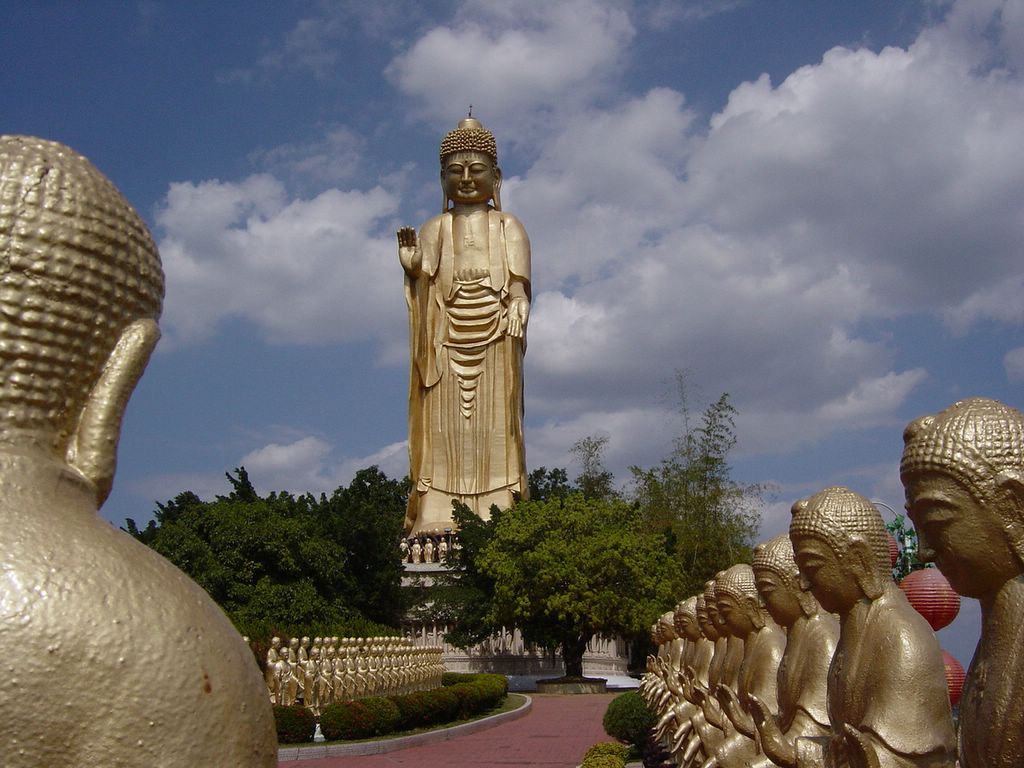
Great Buddha Land:

Main Shrine:

Arhat Garden:
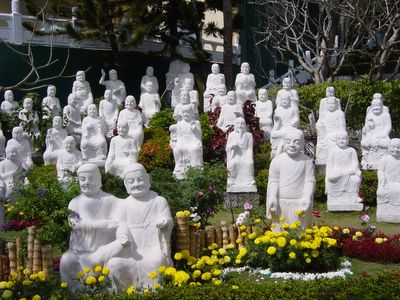
Fo Guang Shan is a large temple complex with international branches. It's a very public place with lots of families milling about like they were in a park. In fact, aside from the many Buddha images and shrines, and the smattering of monastics among the populace going about their business, it was pretty much a park. If I knew the language and talked to monastics, I could have learned more about their practice, but as it was, I spent the entire day walking around the grounds, which even includes a museum, and was never at a loss for where to explore next. There were quite a few shops and vendors, too, which added to the park feel. No money changers, though, so if the Buddha were there, he wouldn't have gone on a rampage.
I kept an open mind about the place, and at the end of the day had more of an appreciation for Chinese Buddhism. I think now that there's no contradiction with it's practical and worldly focus. In ways it makes sense - we live in a practical world. We live in a world, of course it's "worldly". I understand it if they say it makes no sense to deny the worldly aspect of being, focusing just on the spiritual. Mainstream Chinese Buddhism might be emphasizing a balance. Or was that obvious and I'm just figuring it out now?
New Years gatherings are done with and that's a relief. It's my thing with crowds, not unlike public days at the monastery, actually. It's definitely an issue I'll have to confront back at the monastery.
My 30-day visitors visa expires next Friday, and I have to decide soon whether to renew it by leaving the country before then, or just returning to the States and getting back to the monastery. It's starting to get distracting being away from the monastery and I'm starting to understand the concept of "protection of the Sangha". In my case, it would be protection from certain family members who don't know what monastic practice is, don't care to know what it is, and do their best to distract me from the practice. They're trying to catch a fish by throwing paper at the water.
With the smoke from all the extended-family gatherings clearing, I was able to take a solo day trip to a large monastery nearby, called Fo Guang Shan:
Great Buddha Land:
Main Shrine:

Arhat Garden:

Fo Guang Shan is a large temple complex with international branches. It's a very public place with lots of families milling about like they were in a park. In fact, aside from the many Buddha images and shrines, and the smattering of monastics among the populace going about their business, it was pretty much a park. If I knew the language and talked to monastics, I could have learned more about their practice, but as it was, I spent the entire day walking around the grounds, which even includes a museum, and was never at a loss for where to explore next. There were quite a few shops and vendors, too, which added to the park feel. No money changers, though, so if the Buddha were there, he wouldn't have gone on a rampage.
I kept an open mind about the place, and at the end of the day had more of an appreciation for Chinese Buddhism. I think now that there's no contradiction with it's practical and worldly focus. In ways it makes sense - we live in a practical world. We live in a world, of course it's "worldly". I understand it if they say it makes no sense to deny the worldly aspect of being, focusing just on the spiritual. Mainstream Chinese Buddhism might be emphasizing a balance. Or was that obvious and I'm just figuring it out now?
Wednesday, February 09, 2005
Kaohsiung, Taiwan
It's New Years Day in Taiwan. It might be the most important holiday here and is characteristically a family-oriented affair; sort of Thanksgiving and Christmas rolled into one. Yesterday, New Years Eve, we had a big meal at my cousin's in-law's place (where she lives and where I hang out a lot using their wireless and playing with the kids). I kept a low profile since I didn't want to inconvenience anyone by making them feel they had to tend to me and speak to me in English, and just enjoyed myself where I was.
After dinner, I went with my uncle and step-aunt to the airport to pick up my cousin Gary, Audrey's older brother, who was flying in from China for New Years. We go way back. When my brothers and I first visited Taiwan almost 25 years ago, we stayed here and that's when we first met Gary and Audrey. I was one disturbed puppy back then and I can't imagine I made a very good impression. And it's true, Gary and I, although very cordial and friendly, aren't as close as we could be, and the mutual adoration that Audrey and I have developed through the years is more of a fluke.
Back at my uncle's building, close to midnight we went up to the roof where they have a little shrine room and offered prayers to the ancestors and gods, and then at midnight, lit off some major mondo Chinese-style fireworks. And goddam, the fireworks you can get in the U.S. are wimpy compared to these. After Gary lit the first string, he bolted past where I was standing and I understood why real quick. Shit was loud! Scared the bejeebus out of the dog (and believe me there ain't no mo' jeebus in that dog). People were shooting fireworks off all over the place and ships in the harbor were blowing their horns. It was quite festive. A city-wide celebration no doubt.
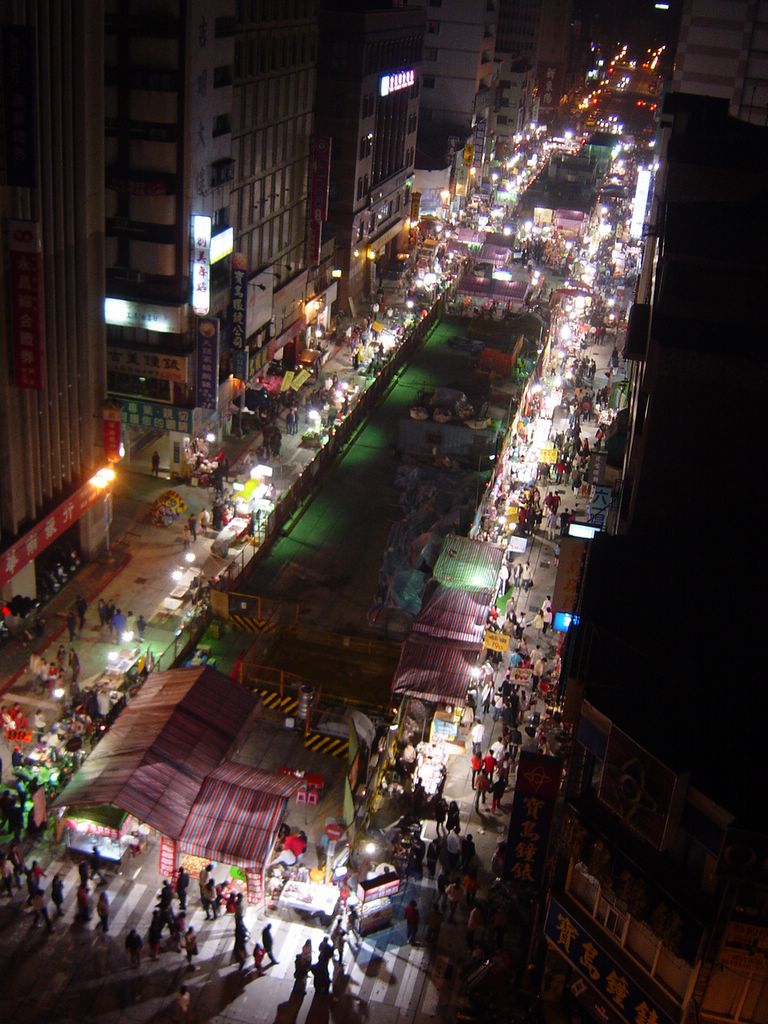
Today, people are out in droves. Traffic on the street by my uncle's building is madness because every New Years they close off one of the adjoining streets for a market that lasts two or three days. A lot of family visitation goes on today, and even I was out for a walk this afternoon when my uncle called and said I could go to my Uncle Jiro's temple because my cousin Peter was hanging out there. So I thought 'why not?' and strolled over and hung out with him and my aunt for a while. It's a Taoist temple, I think. There weren't too many people there - I thought there would be more because of New Years, but maybe people do their praying in the morning.
Neither my aunt or Peter speak English very well, but that's OK. I did learn that my mother has a Master's degree that she got in Japan when my father was working on his Ph.D.
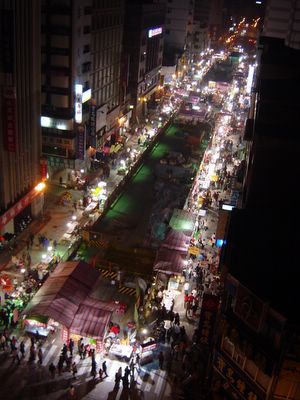
View of the New Years market from the top of my uncle's building, February 8, 2005; 11:55 P.M.:
It's New Years Day in Taiwan. It might be the most important holiday here and is characteristically a family-oriented affair; sort of Thanksgiving and Christmas rolled into one. Yesterday, New Years Eve, we had a big meal at my cousin's in-law's place (where she lives and where I hang out a lot using their wireless and playing with the kids). I kept a low profile since I didn't want to inconvenience anyone by making them feel they had to tend to me and speak to me in English, and just enjoyed myself where I was.
After dinner, I went with my uncle and step-aunt to the airport to pick up my cousin Gary, Audrey's older brother, who was flying in from China for New Years. We go way back. When my brothers and I first visited Taiwan almost 25 years ago, we stayed here and that's when we first met Gary and Audrey. I was one disturbed puppy back then and I can't imagine I made a very good impression. And it's true, Gary and I, although very cordial and friendly, aren't as close as we could be, and the mutual adoration that Audrey and I have developed through the years is more of a fluke.
Back at my uncle's building, close to midnight we went up to the roof where they have a little shrine room and offered prayers to the ancestors and gods, and then at midnight, lit off some major mondo Chinese-style fireworks. And goddam, the fireworks you can get in the U.S. are wimpy compared to these. After Gary lit the first string, he bolted past where I was standing and I understood why real quick. Shit was loud! Scared the bejeebus out of the dog (and believe me there ain't no mo' jeebus in that dog). People were shooting fireworks off all over the place and ships in the harbor were blowing their horns. It was quite festive. A city-wide celebration no doubt.
Today, people are out in droves. Traffic on the street by my uncle's building is madness because every New Years they close off one of the adjoining streets for a market that lasts two or three days. A lot of family visitation goes on today, and even I was out for a walk this afternoon when my uncle called and said I could go to my Uncle Jiro's temple because my cousin Peter was hanging out there. So I thought 'why not?' and strolled over and hung out with him and my aunt for a while. It's a Taoist temple, I think. There weren't too many people there - I thought there would be more because of New Years, but maybe people do their praying in the morning.
Neither my aunt or Peter speak English very well, but that's OK. I did learn that my mother has a Master's degree that she got in Japan when my father was working on his Ph.D.
View of the New Years market from the top of my uncle's building, February 8, 2005; 11:55 P.M.:
Tuesday, February 08, 2005
Paradigm shift:
I had this thought/idea/theory a while back, and once I was spouting about it at the monastery and one of the monks was amazed because he had the exact same thought. Watching my cousin and how much work is required to raise children made me think about it again, and I told it to my cousin and she naturally liked it.
It was about birthdays, and how birthdays of children should be celebrations for the mother, rather than the child. It should be a day that the family appreciates the mother and all the hard work she (theoretically) performed in raising the child. As it is, mothers put in so much effort and work into carrying the child, bearing the child, raising the child, and on top of that, every year on the anniversary that the horrible-blessed event happened, she has to put in more effort to celebrate and entertain the child.
I thought for the child, instead of celebrating the birthday, celebrate some other day of significance, such as the first day they spoke or walked or whatever. But seeing how entrenched celebrating the birthday for the child is, there's not much chance of people thinking differently about it.
So now I think we should keep birthday celebrations the way they are. As the child grows up, have parties, invite kiddie friends, go bowling or miniature golfing, buy a cake and re-use candles left over from last year. But at some point during the celebration or party, attention is turned to the mother and the child is taught to show gratitude to the mother on that day as well. Maybe while everyone else is giving gifts to the child, the child on that day gets, makes, or does something for the mother. Perhaps it should be the father's or other responsible adult's role to orchestrate that portion of the celebration.
Maybe I'm being biased, maybe this is too idealistic, but this is coming from someone who grew up hating his parents, and it staggers my mind the confusion it would have created if I was taught to show gratitude towards my mother every year on my birthday! Of course if my parents put that sort of consideration into teaching me to be grateful, plus on top of that showing the gratitude, my upbringing would have been fundamentally different. Anyway, it's just a theory.
Northern Exposure Quote of the Day:
It's just a theory - Sigmund Freud
I had this thought/idea/theory a while back, and once I was spouting about it at the monastery and one of the monks was amazed because he had the exact same thought. Watching my cousin and how much work is required to raise children made me think about it again, and I told it to my cousin and she naturally liked it.
It was about birthdays, and how birthdays of children should be celebrations for the mother, rather than the child. It should be a day that the family appreciates the mother and all the hard work she (theoretically) performed in raising the child. As it is, mothers put in so much effort and work into carrying the child, bearing the child, raising the child, and on top of that, every year on the anniversary that the horrible-blessed event happened, she has to put in more effort to celebrate and entertain the child.
I thought for the child, instead of celebrating the birthday, celebrate some other day of significance, such as the first day they spoke or walked or whatever. But seeing how entrenched celebrating the birthday for the child is, there's not much chance of people thinking differently about it.
So now I think we should keep birthday celebrations the way they are. As the child grows up, have parties, invite kiddie friends, go bowling or miniature golfing, buy a cake and re-use candles left over from last year. But at some point during the celebration or party, attention is turned to the mother and the child is taught to show gratitude to the mother on that day as well. Maybe while everyone else is giving gifts to the child, the child on that day gets, makes, or does something for the mother. Perhaps it should be the father's or other responsible adult's role to orchestrate that portion of the celebration.
Maybe I'm being biased, maybe this is too idealistic, but this is coming from someone who grew up hating his parents, and it staggers my mind the confusion it would have created if I was taught to show gratitude towards my mother every year on my birthday! Of course if my parents put that sort of consideration into teaching me to be grateful, plus on top of that showing the gratitude, my upbringing would have been fundamentally different. Anyway, it's just a theory.
Northern Exposure Quote of the Day:
It's just a theory - Sigmund Freud
Wednesday, February 02, 2005
Kaohsiung, Taiwan

My cousin used to practice in the Tibetan school. She still has a room in her house set up for – I don’t know what to call it. Practice? Prayer? If she was in the Zen school, it would be a meditation room. It has an altar and other little knick-knacks. It’s a very nice room, worthy of any practitioner’s admiration. I don’t think she practices so much anymore, whatever they do in the Tibetan school. I really need to learn more about the Tibetan practice, as it intrigues me and I'm sure there's plenty I can glean from it. I don’t know if they do Zen style “just sitting”.
She used to practice with a teacher here until she realized it was more of a cult and she became disillusioned with it. That’s the importance of remaining skeptical and wary about one’s practice, whatever it is. Her husband, boyfriend at the time, saw it as a cult, but instead of challenging her on it, he let it run its course until she realized it herself. That was very reasonable of him. That teacher was into guru-worship and expected followers only to listen to her and only read what she’s written. Things like that prima facie set my cultometer peaking.
The Chinese are easily impressed by supernatural shit - fortune telling, magic, prophesying, etc. I think if Jesus was in China and walked on water, every Chinese would be Christian by now, they are so impressed by the supernormal. It makes no difference what the teachings are, dude can walk on water. Well, what would I do if I met someone who could walk on water due to extreme spiritual aptitude and advancement? If he or she had something to say that made sense, I'd be interested, curious, I'd listen. But then I listen to anyone who makes sense, they don't have to walk on water. And I'm just not into worshiping anyone short of Peter Gabriel or whoever's in my bed in the morning (and the last time that's happened was so many years ago it'd make you cry!). I don’t understand why I would be more impressed by someone walking on water than by, say, Stevie Ray Vaughn blowing out some fiery blues licks. Both are remarkable, one person defying hard-written laws of nature, another a dead former heroin addict moving me by playing guitar when I’m not even a fan of the blues. Yo'm sayin'?
I’m planning to visit some temples in the coming weeks. I don’t expect to be too impressed, I’m just making the rounds because the opportunity came up and to keep my mind on my purpose. I don’t need to visit temples to keep my mind on my purpose, but it makes sense for my relatives if I’m entering a monastery that I want to visit temples. Whatever. My impression is that Chinese culture is also too impressed by shows of wealth, and I don’t like how spirituality in Chinese culture is so linked to morality and material benefit. If a wealthy benefactor gives a temple a ton of money to build something, the temple is doing a disservice letting the benefactor think that there is some great spiritual benefit to that act (spiritual benefit in this sense is material because it is being treated like a commodity), or that moral indiscretions are then absolved – morality being defined by the culture.
I’m expecting the temples themselves to be pretty bloody-awful gaudy. Not what I would consider a good use of money. I imagine the justification is for practitioners to feel in the presence of the divine or to wow and impress them. Whatever. Whatever works. I don’t want to criticize Chinese spirituality too much, and I don’t criticize it substantively, because first of all, some of the greatest spiritual works and teachings, in the Zen school in particular, have come from Chinese culture. Second of all, I’m not in the culture, I’m not them, I don’t know how they are affected spiritually on the deepest levels that I’m not even aware of. If I’m criticizing the Chinese spiritual culture on a substantive level, I might as well criticize Tibetan Buddhism with its vivid imagery and deities, and I better be open to fair criticism of my conception of American Zen or American Buddhism as being pointless (unpractical) and unimaginative (or whatever someone else would criticize, I'm not so great at criticizing myself).
I think my cousin fell into the trap of pursuing teachings for the wrong reasons. But after being disillusioned by the teacher she was following, she separated what she felt was real in her belief from that teacher, and has maintained some core belief. And that core belief lets her listen to me to re-attach her to some sort of practice to help deal with child-raising. She isn’t in the Zen school and I’m not trying to push it on her, but I can mention some concept, idea, or practice, and she can relate to it and use it in a way that makes sense to her.
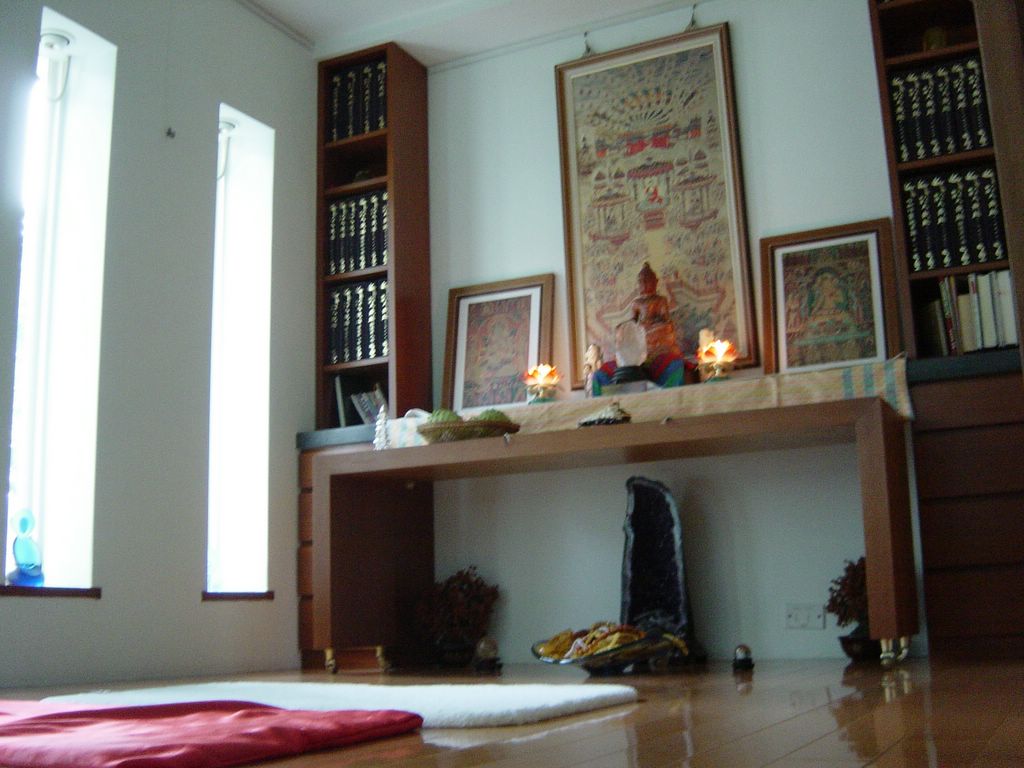
My cousin used to practice in the Tibetan school. She still has a room in her house set up for – I don’t know what to call it. Practice? Prayer? If she was in the Zen school, it would be a meditation room. It has an altar and other little knick-knacks. It’s a very nice room, worthy of any practitioner’s admiration. I don’t think she practices so much anymore, whatever they do in the Tibetan school. I really need to learn more about the Tibetan practice, as it intrigues me and I'm sure there's plenty I can glean from it. I don’t know if they do Zen style “just sitting”.
She used to practice with a teacher here until she realized it was more of a cult and she became disillusioned with it. That’s the importance of remaining skeptical and wary about one’s practice, whatever it is. Her husband, boyfriend at the time, saw it as a cult, but instead of challenging her on it, he let it run its course until she realized it herself. That was very reasonable of him. That teacher was into guru-worship and expected followers only to listen to her and only read what she’s written. Things like that prima facie set my cultometer peaking.
The Chinese are easily impressed by supernatural shit - fortune telling, magic, prophesying, etc. I think if Jesus was in China and walked on water, every Chinese would be Christian by now, they are so impressed by the supernormal. It makes no difference what the teachings are, dude can walk on water. Well, what would I do if I met someone who could walk on water due to extreme spiritual aptitude and advancement? If he or she had something to say that made sense, I'd be interested, curious, I'd listen. But then I listen to anyone who makes sense, they don't have to walk on water. And I'm just not into worshiping anyone short of Peter Gabriel or whoever's in my bed in the morning (and the last time that's happened was so many years ago it'd make you cry!). I don’t understand why I would be more impressed by someone walking on water than by, say, Stevie Ray Vaughn blowing out some fiery blues licks. Both are remarkable, one person defying hard-written laws of nature, another a dead former heroin addict moving me by playing guitar when I’m not even a fan of the blues. Yo'm sayin'?
I’m planning to visit some temples in the coming weeks. I don’t expect to be too impressed, I’m just making the rounds because the opportunity came up and to keep my mind on my purpose. I don’t need to visit temples to keep my mind on my purpose, but it makes sense for my relatives if I’m entering a monastery that I want to visit temples. Whatever. My impression is that Chinese culture is also too impressed by shows of wealth, and I don’t like how spirituality in Chinese culture is so linked to morality and material benefit. If a wealthy benefactor gives a temple a ton of money to build something, the temple is doing a disservice letting the benefactor think that there is some great spiritual benefit to that act (spiritual benefit in this sense is material because it is being treated like a commodity), or that moral indiscretions are then absolved – morality being defined by the culture.
I’m expecting the temples themselves to be pretty bloody-awful gaudy. Not what I would consider a good use of money. I imagine the justification is for practitioners to feel in the presence of the divine or to wow and impress them. Whatever. Whatever works. I don’t want to criticize Chinese spirituality too much, and I don’t criticize it substantively, because first of all, some of the greatest spiritual works and teachings, in the Zen school in particular, have come from Chinese culture. Second of all, I’m not in the culture, I’m not them, I don’t know how they are affected spiritually on the deepest levels that I’m not even aware of. If I’m criticizing the Chinese spiritual culture on a substantive level, I might as well criticize Tibetan Buddhism with its vivid imagery and deities, and I better be open to fair criticism of my conception of American Zen or American Buddhism as being pointless (unpractical) and unimaginative (or whatever someone else would criticize, I'm not so great at criticizing myself).
I think my cousin fell into the trap of pursuing teachings for the wrong reasons. But after being disillusioned by the teacher she was following, she separated what she felt was real in her belief from that teacher, and has maintained some core belief. And that core belief lets her listen to me to re-attach her to some sort of practice to help deal with child-raising. She isn’t in the Zen school and I’m not trying to push it on her, but I can mention some concept, idea, or practice, and she can relate to it and use it in a way that makes sense to her.
Monday, January 31, 2005
Kaohsiung, Taiwan
My cousin, her husband, and her two babies.
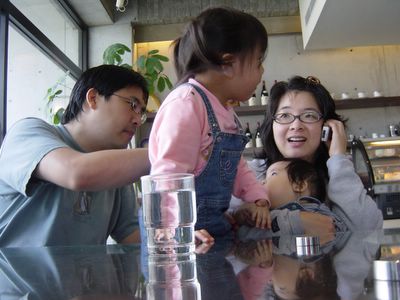
Mostly I'm just hanging out with my cousin and her kids. When you have kids, everything is centered on the kids. Here we were taking care of the kids while having lunch. Later, we abandoned taking care of the kids at the museum, opting for taking care of the kids in the park.
My cousin, her husband, and her two babies.
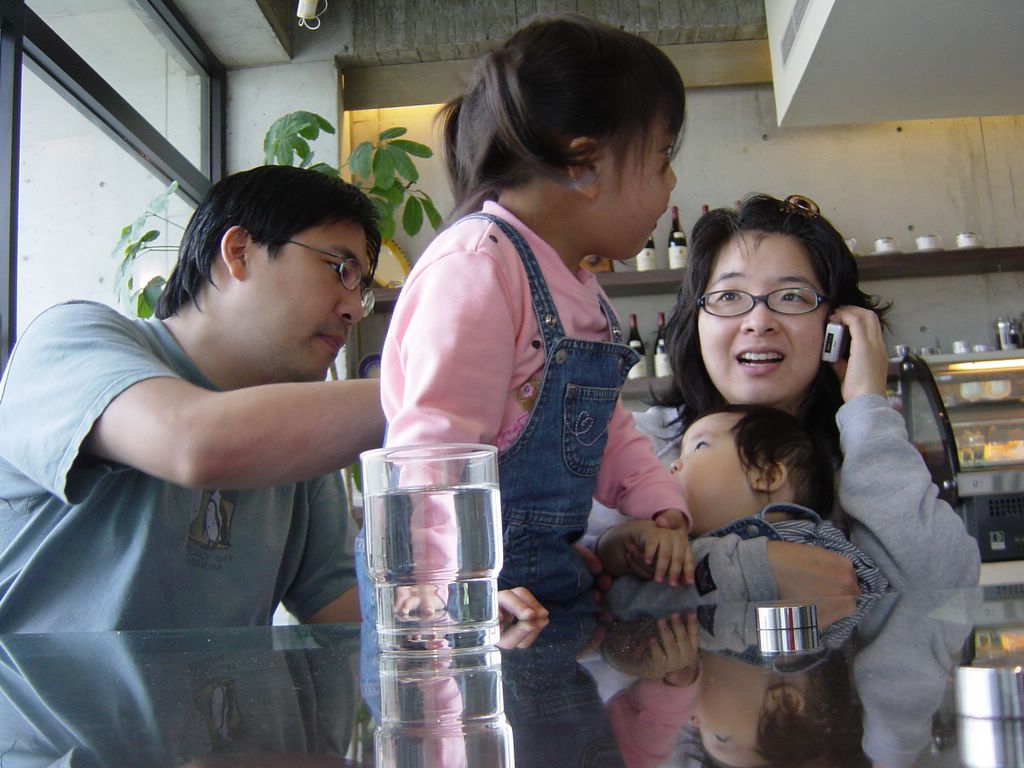
Mostly I'm just hanging out with my cousin and her kids. When you have kids, everything is centered on the kids. Here we were taking care of the kids while having lunch. Later, we abandoned taking care of the kids at the museum, opting for taking care of the kids in the park.
Friday, January 28, 2005
Kaohsiung, Taiwan
I'm still getting over jetlag, I think. I'm sleeping normal local hours, but I hit walls during the day when my energy just plunges. And going to sleep around 10:00 P.M. is after about two hours of herculean effort to stay awake. And I'm starting to worry about my coffee addiction.
What I mentioned about the purpose of my wearing Deer Park monastic clothing over here is valid to me, but it does have twists in this culturally Chinese society. One of my cousin's friends asked about what I was wearing, and as soon as my cousin told her I was a monastic aspirant, she understood. Understanding the monastic part, she then asked if I had some sort of problem I was trying to get away from! Mainstream Chinese culture is very practical and worldly, so the immediate thought about someone entering a monastery is that they are trying to get away from something. My cousin had to reassure her that some people sincerely want to enter monasteries to develop themselves internally. I think that's along the lines of what my cousin told her.
I think Zen is a bit player in the mainstream Chinese cultural understanding of Buddhism, which makes sense since mainstream Chinese culture is very practical, and even spiritual understanding is tied into material benefits. Perhaps to most Chinese, Zen is just about sitting (and when you're sitting, you're meditating, and when you're not sitting, you're not meditating), and the nitty-gritty philosophical aspects of it are just kinda way out there. So it’s better to stick to the tangible aspects of what sitting’s about using metaphors for what sitting trains our minds to do.
My stock description for sitting is imagining a stream or a brook, and thoughts are like leaves floating by on the surface. We tend to pick up the leaves and think about them concretely, analyzing them, developing feelings regarding them. Maybe an incident with someone, maybe something you did or said that you’re reinforcing or regretting, maybe something you read about or saw. Maybe you feel bad, angry, nervous, or anxious because of the thought. While sitting, we try not to pick the leaves out of the water, but sometimes it just happens in the course of brain activity, the flowing stream. It happens, it’s normal, but while sitting, once we realize we’ve picked a leaf out of the water, we recognize it and put it back in and let it go and flow away. It’s a skill to develop, and maybe the next few leaves flow by without incident, but eventually another one comes by that gets our brain’s attention and we pick it up until we realize we’ve picked it up, and then we consciously recognize it and let it go. Over and over it happens, and that’s OK, that’s part of the process to eventually get the mind to a point where it’s in different states. You don’t do anything to get to those states, it happens naturally sooner or later, and you only recognize it once you’ve come out of it. What it means to an individual is subjective, though. Some people might be ‘so what?’ about it while others find it relaxing. Some people find it revelatory. I just think it’s neat.
It’s good to come up with new metaphors to keep things fresh, and they’re pretty easy to find in the things you do. These descriptions are to distinguish a proper meditative state of mind to be in from our ordinary linear, analytical thinking minds. Another one is a bike coasting along, and that’s sitting. When a thought comes along and I attach to it and think about it, that’s hitting a hill and having to pedal and crank and put effort into it. The visualization is to put the bike into a downhill coast again to stop the active thinking. The cranks and the chain should not be moving as thoughts come and go.
A more specialized metaphor is of electric basses with active or passive pickups. Electric guitars and basses don’t need electricity to work. Pickups are just magnets that read the string vibrations and send them via wires to an amplifier, which does need electricity to transform the vibrations into sound waves. But more and more common in the electric bass market are active electronics which require an onboard battery to power the pickups and/or a preamp. The benefit is boosting the bass signal at its source so that it cuts through mixes more easily, and is arguably more controllable. Thinking linear, concrete thoughts is like active pickups, and you want to turn the electronics off so that the signal is passive, no boost. The string vibrates in the electromagnetic field and sends one frequency through to the amp, play another note and another frequency is played.
I'm still getting over jetlag, I think. I'm sleeping normal local hours, but I hit walls during the day when my energy just plunges. And going to sleep around 10:00 P.M. is after about two hours of herculean effort to stay awake. And I'm starting to worry about my coffee addiction.
What I mentioned about the purpose of my wearing Deer Park monastic clothing over here is valid to me, but it does have twists in this culturally Chinese society. One of my cousin's friends asked about what I was wearing, and as soon as my cousin told her I was a monastic aspirant, she understood. Understanding the monastic part, she then asked if I had some sort of problem I was trying to get away from! Mainstream Chinese culture is very practical and worldly, so the immediate thought about someone entering a monastery is that they are trying to get away from something. My cousin had to reassure her that some people sincerely want to enter monasteries to develop themselves internally. I think that's along the lines of what my cousin told her.
I think Zen is a bit player in the mainstream Chinese cultural understanding of Buddhism, which makes sense since mainstream Chinese culture is very practical, and even spiritual understanding is tied into material benefits. Perhaps to most Chinese, Zen is just about sitting (and when you're sitting, you're meditating, and when you're not sitting, you're not meditating), and the nitty-gritty philosophical aspects of it are just kinda way out there. So it’s better to stick to the tangible aspects of what sitting’s about using metaphors for what sitting trains our minds to do.
My stock description for sitting is imagining a stream or a brook, and thoughts are like leaves floating by on the surface. We tend to pick up the leaves and think about them concretely, analyzing them, developing feelings regarding them. Maybe an incident with someone, maybe something you did or said that you’re reinforcing or regretting, maybe something you read about or saw. Maybe you feel bad, angry, nervous, or anxious because of the thought. While sitting, we try not to pick the leaves out of the water, but sometimes it just happens in the course of brain activity, the flowing stream. It happens, it’s normal, but while sitting, once we realize we’ve picked a leaf out of the water, we recognize it and put it back in and let it go and flow away. It’s a skill to develop, and maybe the next few leaves flow by without incident, but eventually another one comes by that gets our brain’s attention and we pick it up until we realize we’ve picked it up, and then we consciously recognize it and let it go. Over and over it happens, and that’s OK, that’s part of the process to eventually get the mind to a point where it’s in different states. You don’t do anything to get to those states, it happens naturally sooner or later, and you only recognize it once you’ve come out of it. What it means to an individual is subjective, though. Some people might be ‘so what?’ about it while others find it relaxing. Some people find it revelatory. I just think it’s neat.
It’s good to come up with new metaphors to keep things fresh, and they’re pretty easy to find in the things you do. These descriptions are to distinguish a proper meditative state of mind to be in from our ordinary linear, analytical thinking minds. Another one is a bike coasting along, and that’s sitting. When a thought comes along and I attach to it and think about it, that’s hitting a hill and having to pedal and crank and put effort into it. The visualization is to put the bike into a downhill coast again to stop the active thinking. The cranks and the chain should not be moving as thoughts come and go.
A more specialized metaphor is of electric basses with active or passive pickups. Electric guitars and basses don’t need electricity to work. Pickups are just magnets that read the string vibrations and send them via wires to an amplifier, which does need electricity to transform the vibrations into sound waves. But more and more common in the electric bass market are active electronics which require an onboard battery to power the pickups and/or a preamp. The benefit is boosting the bass signal at its source so that it cuts through mixes more easily, and is arguably more controllable. Thinking linear, concrete thoughts is like active pickups, and you want to turn the electronics off so that the signal is passive, no boost. The string vibrates in the electromagnetic field and sends one frequency through to the amp, play another note and another frequency is played.
Wednesday, January 26, 2005
Kaohsiung, Taiwan
Right, so what am I doing here? I'm loving the tropical weather. Something just always feels very much like home whenever I'm in it, and in late January it's really, really pleasant. 70 degree temps in the daytime, in the 60s in the morning and nights; just a touch of ubiquitous humidity.
New Jersey is very distant. Deer Park is very distant, but the monastics are just a time zone away in Vietnam. I don't think I'll be able to make it over there to join the monastics for any part of their speaking tour, though. I also brought my two monastic shirt/robes that I'm wearing all the time to remind me of my practice and what I'm doing here. I don't know. When I took the Five Mindfulness Trainings, I didn't ask for a Dharma name to aid me in my practice because I didn't understand what receiving a Dharma name had to do with receiving the trainings. But on this hiatus from the monastery, overseas in Taiwan, wearing monastic clothing is definitely helping keep my focus. It's that identity-defined-by-outside-perception thing. I'm wearing this thing that isn't normal, so when people see me, they may be like, "why the hell is he wearing that?" Why, indeed, and the answer is mine for myself. It helps define my behavior. There are behaviors that are simply inappropriate while I'm wearing this.
At the monastery it doesn't matter what I wear. Even in the U.S. it doesn't matter because the clothing doesn't mean anything to anyone there. But here, even though people might not definitely identify this as monastic clothing, my perception of them is that they might get that sense since this is a culturaly Buddhist society. So it's my perception of their perception of me. Hm, why can't I just say it's my perception of myself then?
Anyway, as long as I'm here I'll be visiting temples and monasteries just to have a broader perspective of this religious institution, even though the institutional aspect doesn't interest me at all. The broader perspective of it may be important. There are a lot of resources online, and once I look more into them, my uncle and cousin can help with suggestions on how to visit them. Maybe even stay at some if they have retreats.
My cousin's husband is a computer geek and so their house is wireless. I'm telling you, this wireless thing is totally rad!
Right, so what am I doing here? I'm loving the tropical weather. Something just always feels very much like home whenever I'm in it, and in late January it's really, really pleasant. 70 degree temps in the daytime, in the 60s in the morning and nights; just a touch of ubiquitous humidity.
New Jersey is very distant. Deer Park is very distant, but the monastics are just a time zone away in Vietnam. I don't think I'll be able to make it over there to join the monastics for any part of their speaking tour, though. I also brought my two monastic shirt/robes that I'm wearing all the time to remind me of my practice and what I'm doing here. I don't know. When I took the Five Mindfulness Trainings, I didn't ask for a Dharma name to aid me in my practice because I didn't understand what receiving a Dharma name had to do with receiving the trainings. But on this hiatus from the monastery, overseas in Taiwan, wearing monastic clothing is definitely helping keep my focus. It's that identity-defined-by-outside-perception thing. I'm wearing this thing that isn't normal, so when people see me, they may be like, "why the hell is he wearing that?" Why, indeed, and the answer is mine for myself. It helps define my behavior. There are behaviors that are simply inappropriate while I'm wearing this.
At the monastery it doesn't matter what I wear. Even in the U.S. it doesn't matter because the clothing doesn't mean anything to anyone there. But here, even though people might not definitely identify this as monastic clothing, my perception of them is that they might get that sense since this is a culturaly Buddhist society. So it's my perception of their perception of me. Hm, why can't I just say it's my perception of myself then?
Anyway, as long as I'm here I'll be visiting temples and monasteries just to have a broader perspective of this religious institution, even though the institutional aspect doesn't interest me at all. The broader perspective of it may be important. There are a lot of resources online, and once I look more into them, my uncle and cousin can help with suggestions on how to visit them. Maybe even stay at some if they have retreats.
My cousin's husband is a computer geek and so their house is wireless. I'm telling you, this wireless thing is totally rad!
Kaohsiung, Taiwan
So where in the story was I? Oh, right. Two weeks in New Jersey. What a drag. Bitter cold winter temps, culminating in a huge blizzard in which me and my brother made the genius-worthy decision to drive down to Philadelphia to visit our other brother. Can you say “driving down the NJ Turnpike at 35 miles an hour”? I did all the driving, too, since whenever we went into New York, my brother did the driving (and parking, which I still have a neurosis about even though parking in NYC is much easier and saner than my experience in San Francisco ever was).
We only went into New York once this time to see the revival of Stephen Sondheim’s “Pacific Overtures” at Studio 54. It wasn’t great, but it’s always heart-warming seeing an all Asian/Asian American cast. “Pacific Overtures” originally ran in 1976. It boggles the mind trying to imagine what prompted Sondheim to put on a historical musical about the opening of Japan to the West using an all Asian/Asian American male cast. I’m sure he didn’t pitch the idea saying, “It’s a guaranteed hit!” But it had a healthy run back then. The current limited engagement features the delectable and talented B.D. Wong, but was otherwise lackluster. It didn’t deliver emotionally and it seemed the cast couldn’t handle the complexity of Sondheim triple-quadruple(-quintuple?) counterpoint. Unlike the original, this production included women in the cast which I found distracting, since the original mimicked traditional kabuki theater where all roles are played by men. The humor in the scene with geishas fell flat because they weren’t all men playing the parts. This production also missed by not completely changing the finale, which was supposed to be a commentary on Japan today, but Japan in 2005 is very different from Japan in 1976. They had the opportunity to comment on Japanese militarism and how it was sourced in the West, but then bring it back around to subtly comment on American militarism today. Now that would’ve been brilliant.
But now I’m in Taiwan, after an arduous flight which left Monday, and arrived today, Wednesday, completely losing Tuesday somewhere along the way. My uncle picked me up from the airport around noon and I’ve spent the last several hours battling jet lag and hanging out with my wonderful cousin and her wonderful daughters (aged 2 and 7 months). There’s such a big difference in the way these children are being raised and the way my brother’s kid is being raised. I’m not criticizing anyone, I just see the benefit of raising children within a family community, and I don't think my crazy parents (not to mention the possibly equally crazy parents on the mother's side) qualifies.
So where in the story was I? Oh, right. Two weeks in New Jersey. What a drag. Bitter cold winter temps, culminating in a huge blizzard in which me and my brother made the genius-worthy decision to drive down to Philadelphia to visit our other brother. Can you say “driving down the NJ Turnpike at 35 miles an hour”? I did all the driving, too, since whenever we went into New York, my brother did the driving (and parking, which I still have a neurosis about even though parking in NYC is much easier and saner than my experience in San Francisco ever was).
We only went into New York once this time to see the revival of Stephen Sondheim’s “Pacific Overtures” at Studio 54. It wasn’t great, but it’s always heart-warming seeing an all Asian/Asian American cast. “Pacific Overtures” originally ran in 1976. It boggles the mind trying to imagine what prompted Sondheim to put on a historical musical about the opening of Japan to the West using an all Asian/Asian American male cast. I’m sure he didn’t pitch the idea saying, “It’s a guaranteed hit!” But it had a healthy run back then. The current limited engagement features the delectable and talented B.D. Wong, but was otherwise lackluster. It didn’t deliver emotionally and it seemed the cast couldn’t handle the complexity of Sondheim triple-quadruple(-quintuple?) counterpoint. Unlike the original, this production included women in the cast which I found distracting, since the original mimicked traditional kabuki theater where all roles are played by men. The humor in the scene with geishas fell flat because they weren’t all men playing the parts. This production also missed by not completely changing the finale, which was supposed to be a commentary on Japan today, but Japan in 2005 is very different from Japan in 1976. They had the opportunity to comment on Japanese militarism and how it was sourced in the West, but then bring it back around to subtly comment on American militarism today. Now that would’ve been brilliant.
But now I’m in Taiwan, after an arduous flight which left Monday, and arrived today, Wednesday, completely losing Tuesday somewhere along the way. My uncle picked me up from the airport around noon and I’ve spent the last several hours battling jet lag and hanging out with my wonderful cousin and her wonderful daughters (aged 2 and 7 months). There’s such a big difference in the way these children are being raised and the way my brother’s kid is being raised. I’m not criticizing anyone, I just see the benefit of raising children within a family community, and I don't think my crazy parents (not to mention the possibly equally crazy parents on the mother's side) qualifies.
Friday, January 21, 2005
Englewood Cliffs, NJ
For having no reason to go to Taiwan, I can't well say I'm not ready to go. Not knowing what I'm going to do there, I have no packing list. After two weeks in New Jersey being distracted and goofing off, going to Taiwan will be an opportunity to quiet down and focus and be more disciplined, um, with the monastic practice thingie.
Not that I've been way off on the practice. It's true that I haven't been particularly disciplined about sitting or walking, or other setting specific times for . . . practicing the practice, but the practice has always been right here. Or not, but when it hasn't, I've been aware of that, too.
There's a difference between the practice - the practice of mindful awareness and mindful being, and practicing for it. Sitting in the morning and the evening, bookending each day, is practicing mindfulness, which is what we're trying to maintain at all times - what we call the practice. But you knew all this.
Actually, a lot of what it has been lately is noticing when I do something without some degree of full awareness. It's particularly egregious with the smaller things, so I'll notice immediately after the fact if I walk across the kitchen somewhat mindlessly. There's no chastisement, just noticing it and doing my best at it.
Furthermore, it's been really cold in New Jersey, so there have been times when I've been outside and would think, "I am mindful that it's too friggin' cold to walk mindfully" and allow myself to rush to get out of the cold. Mindfulness of not being mindful, I think, is oonsonant with the practice, but that's a whole sticky, easily misapplied, philosophical conundrum that I won't get into.
I don't know if any of this practice is really being tested. Relations with my family are pretty benign at this point, and with our contentious history, I don't know if my keeping quiet when they say something that bugs me is a result of my practicing or if it's just me not dealing with it. Probably both at this point.
For having no reason to go to Taiwan, I can't well say I'm not ready to go. Not knowing what I'm going to do there, I have no packing list. After two weeks in New Jersey being distracted and goofing off, going to Taiwan will be an opportunity to quiet down and focus and be more disciplined, um, with the monastic practice thingie.
Not that I've been way off on the practice. It's true that I haven't been particularly disciplined about sitting or walking, or other setting specific times for . . . practicing the practice, but the practice has always been right here. Or not, but when it hasn't, I've been aware of that, too.
There's a difference between the practice - the practice of mindful awareness and mindful being, and practicing for it. Sitting in the morning and the evening, bookending each day, is practicing mindfulness, which is what we're trying to maintain at all times - what we call the practice. But you knew all this.
Actually, a lot of what it has been lately is noticing when I do something without some degree of full awareness. It's particularly egregious with the smaller things, so I'll notice immediately after the fact if I walk across the kitchen somewhat mindlessly. There's no chastisement, just noticing it and doing my best at it.
Furthermore, it's been really cold in New Jersey, so there have been times when I've been outside and would think, "I am mindful that it's too friggin' cold to walk mindfully" and allow myself to rush to get out of the cold. Mindfulness of not being mindful, I think, is oonsonant with the practice, but that's a whole sticky, easily misapplied, philosophical conundrum that I won't get into.
I don't know if any of this practice is really being tested. Relations with my family are pretty benign at this point, and with our contentious history, I don't know if my keeping quiet when they say something that bugs me is a result of my practicing or if it's just me not dealing with it. Probably both at this point.
Wednesday, January 12, 2005
Englewood Cliffs, NJ
It's like for the past two months, I've been a balloon getting blown up. These past few days back in New Jersey have been like all the air escaping out of the balloon, flying around the room and landing precariously on the edge of a lamp shade. Now it's time to re-attach, re-connect, re-engage, and go deeper. Deeper in life if not the practice, but yes, need to get back to the practice. The practice is life. Life is breathing, walking, being - not what all these people on the outside are doing. Whoops, I guess that means what you all are doing. But it's all the same, I could be doing that. There's an attraction to going back to secular life and using the practice to live it more deeply. That's what all those visitors to the monastery were doing, I suppose.
And I suppose much of the purpose of spending these few months away from the monastery is to make sure I can do that to some extent. Not being attached to the monastery, the practice there, or running away from something to be there. There shouldn't be a separation between the basic practice there and the basic practice out here. If I can't maintain the practice out here, that means I'm attached to the practice there or I'm running away from something. If I can't go deeper out here, then I would doubt my ability to really go deeper as a monastic.
The reason for entering the monastery is to remove myself from distractions and stimulus that lead to a direct engagement of desire and worldly concerns, and by doing so being able to go deeper into the monastic practice - sitting, breathing, being.
Going deeper in secular life means using the practice techniques to engage life in the present moment. If I'm working, really working. If I'm drinking coffee, really drinking coffee. Being aware of all those moments by concentrating on breathing which is the reminder of the moment since we're breathing at every moment of our lives. It's harder on the outside because you're constantly bombarded by stimulus, your desire is preyed upon by corporate advertising, and worldly pressures are constantly at your heels to one degree or another.
It wasn't clear to me what I was doing until I left the monastery, but there is a purpose in these next few months before I ostensibly return to Deer Park. The purpose is to go deeper. Perhaps the purpose of the purpose is to remove any remaining doubts about heading down the monastic path.
It's like for the past two months, I've been a balloon getting blown up. These past few days back in New Jersey have been like all the air escaping out of the balloon, flying around the room and landing precariously on the edge of a lamp shade. Now it's time to re-attach, re-connect, re-engage, and go deeper. Deeper in life if not the practice, but yes, need to get back to the practice. The practice is life. Life is breathing, walking, being - not what all these people on the outside are doing. Whoops, I guess that means what you all are doing. But it's all the same, I could be doing that. There's an attraction to going back to secular life and using the practice to live it more deeply. That's what all those visitors to the monastery were doing, I suppose.
And I suppose much of the purpose of spending these few months away from the monastery is to make sure I can do that to some extent. Not being attached to the monastery, the practice there, or running away from something to be there. There shouldn't be a separation between the basic practice there and the basic practice out here. If I can't maintain the practice out here, that means I'm attached to the practice there or I'm running away from something. If I can't go deeper out here, then I would doubt my ability to really go deeper as a monastic.
The reason for entering the monastery is to remove myself from distractions and stimulus that lead to a direct engagement of desire and worldly concerns, and by doing so being able to go deeper into the monastic practice - sitting, breathing, being.
Going deeper in secular life means using the practice techniques to engage life in the present moment. If I'm working, really working. If I'm drinking coffee, really drinking coffee. Being aware of all those moments by concentrating on breathing which is the reminder of the moment since we're breathing at every moment of our lives. It's harder on the outside because you're constantly bombarded by stimulus, your desire is preyed upon by corporate advertising, and worldly pressures are constantly at your heels to one degree or another.
It wasn't clear to me what I was doing until I left the monastery, but there is a purpose in these next few months before I ostensibly return to Deer Park. The purpose is to go deeper. Perhaps the purpose of the purpose is to remove any remaining doubts about heading down the monastic path.
Sunday, January 09, 2005
Deer Park Monastery, Escondido, CA
My last day at the monastery. The monastics leave for Vietnam in the late afternoon. I'm hoping to catch a ride with one of the laypeople into Escondido town where I'm staying at a motel tonight so that I can get to the bus station on time to catch a bus to San Diego airport in time to catch my early flight to New Jersey.
Looking back, I don't think this weblog has been all that successful in describing my experience at the monastery. Specifically, I think of all the things that I've left out. I think positive stuff has largely been left out and almost all specifics. Everything is in terms of generalities. If I were a better writer, I could have included more description, but that's a talent I don't have. If I were a writer, I think I'd be better at writing technical manuals :p
Look! When I wrote "specifically", I still generalized in broad strokes.
Boy, do I hope laypeople come up to bid the monastics farewell so I can bum a ride into town. It is raining as it has been raining nonstop for the last two days, and if I don't get a ride into town, I have to walk for almost an hour to get to the nearest (unsheltered) bus stop to get to town.
I admit now that one of the things I have to deal with in this community is living in close quarters with other people. Bleah! Too general!
I had a problem when other guests were placed in my room. That's better. But strangely, it was better when more than one other guest was placed in my room. Go fig. I won't go into detail (bleah, avoiding the specifics again), but it's something I will want to face and deal with when I come back in April. I had the luxury these past two months of frequently not having guests placed in my room, but when I come back, I will tell Norman to put short-term guests in with me on a more regular basis. Challenge this attachment to privacy and see how I deal with it, because breaking the attachment would be requisite for joining this community and will be good for me anyway even if I don't.
I don't know if that was the least of my problems or the most. I hope it was the most. I'll have several months of hiatus now to work things out.
My last day at the monastery. The monastics leave for Vietnam in the late afternoon. I'm hoping to catch a ride with one of the laypeople into Escondido town where I'm staying at a motel tonight so that I can get to the bus station on time to catch a bus to San Diego airport in time to catch my early flight to New Jersey.
Looking back, I don't think this weblog has been all that successful in describing my experience at the monastery. Specifically, I think of all the things that I've left out. I think positive stuff has largely been left out and almost all specifics. Everything is in terms of generalities. If I were a better writer, I could have included more description, but that's a talent I don't have. If I were a writer, I think I'd be better at writing technical manuals :p
Look! When I wrote "specifically", I still generalized in broad strokes.
Boy, do I hope laypeople come up to bid the monastics farewell so I can bum a ride into town. It is raining as it has been raining nonstop for the last two days, and if I don't get a ride into town, I have to walk for almost an hour to get to the nearest (unsheltered) bus stop to get to town.
I admit now that one of the things I have to deal with in this community is living in close quarters with other people. Bleah! Too general!
I had a problem when other guests were placed in my room. That's better. But strangely, it was better when more than one other guest was placed in my room. Go fig. I won't go into detail (bleah, avoiding the specifics again), but it's something I will want to face and deal with when I come back in April. I had the luxury these past two months of frequently not having guests placed in my room, but when I come back, I will tell Norman to put short-term guests in with me on a more regular basis. Challenge this attachment to privacy and see how I deal with it, because breaking the attachment would be requisite for joining this community and will be good for me anyway even if I don't.
I don't know if that was the least of my problems or the most. I hope it was the most. I'll have several months of hiatus now to work things out.
Saturday, January 08, 2005
Deer Park Monastery, Escondido, CA
I don’t think I would have a problem with the community aspect of this monastery. I don’t think I would have a problem with the conformity aspect of this monastery. I think the problem I would have is keeping up my guard in respect to the community and conformity aspects of this monastery. In any community I join, I would insist on keeping my own views and interpretations.
It strikes me as eerie when I listen to one of the monks repeating the teachings of Thich Nhat Hanh to a layperson or a guest. It’s like someone placed these ideas in their heads, and given the right trigger, they start spouting the teaching with very little variation or personal input, interpretation, or expression. The cultometer starts reacting whenever I hear, “Our teacher says…”.
Hm, I feel I’m being legitimately critical about this, but I also think negativity is seeping into the observation.
I think I’m right about this in general – that’s the critical part. But I think I have specific people in mind when I say all this – that’s the negative part. I have to separate the critical part from the negative part, even though it was things people said that sparked the critical part. That’s hard, but I think it’s possible. I think the thought is right, but the feeling is wrong.
It’s the difference between being critical and criticizing, and I don’t want to criticize people. But what if I can’t express something critical without the background or context which is criticizing?
What I mean is that I don’t mind becoming part of the community-body as long as that doesn’t mean losing my individuality or being expected to think how everyone else thinks, or to expound on the teacher’s teachings only as he intended them. I don’t ever want to repeat anything I like of what Thich Nhat Hanh has said just for the sake of it. I’d only do it if I can offer what it means to me, as if it was coming from me. Otherwise, they can just go read his books or buy his CD/DVDs.
I am sure, though, that lots of time my interpretation deviates from the intended teaching. Then what?
I don’t think I would have a problem with the community aspect of this monastery. I don’t think I would have a problem with the conformity aspect of this monastery. I think the problem I would have is keeping up my guard in respect to the community and conformity aspects of this monastery. In any community I join, I would insist on keeping my own views and interpretations.
It strikes me as eerie when I listen to one of the monks repeating the teachings of Thich Nhat Hanh to a layperson or a guest. It’s like someone placed these ideas in their heads, and given the right trigger, they start spouting the teaching with very little variation or personal input, interpretation, or expression. The cultometer starts reacting whenever I hear, “Our teacher says…”.
Hm, I feel I’m being legitimately critical about this, but I also think negativity is seeping into the observation.
I think I’m right about this in general – that’s the critical part. But I think I have specific people in mind when I say all this – that’s the negative part. I have to separate the critical part from the negative part, even though it was things people said that sparked the critical part. That’s hard, but I think it’s possible. I think the thought is right, but the feeling is wrong.
It’s the difference between being critical and criticizing, and I don’t want to criticize people. But what if I can’t express something critical without the background or context which is criticizing?
What I mean is that I don’t mind becoming part of the community-body as long as that doesn’t mean losing my individuality or being expected to think how everyone else thinks, or to expound on the teacher’s teachings only as he intended them. I don’t ever want to repeat anything I like of what Thich Nhat Hanh has said just for the sake of it. I’d only do it if I can offer what it means to me, as if it was coming from me. Otherwise, they can just go read his books or buy his CD/DVDs.
I am sure, though, that lots of time my interpretation deviates from the intended teaching. Then what?
Wednesday, January 05, 2005
Deer Park Monastery, Escondido, CA
Dogma:
I need to be able to balance my critical mind with negativity. The critical mind is a good thing to have, the negativity is not. And if anyone told me that my critical mind is not a good thing to have, the cult-behavior red alerts should go off like smoke detectors any time I cook.
Exhortations that practitioners need to practice with a community is right at the doorstep of cult-like behavior. If they say you should practice with a community, that’s a little better, but not by a whole lot. First of all, I don’t like anyone telling me what I need. I also don’t like the suggestion that someone who practices alone is somehow inferior to people who find, have, and practice with a community. There definitely are benefits of practicing with a community, but I reject those value judgments. Besides, why should an individual need a community if the community doesn’t need the individual? I’ll need this community when it needs me, otherwise where’s the equanimity? I’m complete without a community, and anyone who tells me different is trying to sell me truth and love through tofu.
There is also a danger in the Five Mindfulness Trainings becoming dogmatic if not viewed critically. As I’ve mentioned, the Five Mindfulness Trainings are like precepts, but they aren’t proscriptions on behavior or commandments. They aren’t meant to be strictly “followed” and they are not “broken” if they aren’t followed. They are trainings in mindfulness, being mindful about life and living beings, the way we use speech, our consumption, sexual relations, and possessions and exploitation/social injustice. Actually, I think the Five Mindfulness Trainings are trainings in being critical, and the value in developing that critical mind is more important than the substance of the trainings which can easily fall into dogma.
There’s also a requirement that the Five Mindfulness Trainings be read or recited once a month, preferably with a community. That encouragement of a community I think is reasonable, because for the Five Mindfulness Trainings, it’s a matter of support or there being a witness to impress the responsibility needed to take the trainings seriously and diligently (already the danger of falling into dogma). And the trainings absolutely must be read or recited once in three months or the transmission “is lost”. These requirements are about being mindful, more so than any ephemeral, ethereal, mystic “transmission”. Without this requirement nagging at you once a month or within three months, it’s easy to let them slip and forget about them. The substance in the transmission is more a skillful means to get people to treat them seriously.
I think once people have taken the Five Mindfulness Trainings and developed a critical mind about them and their function, they should be encouraged to refine the trainings to apply specifically to themselves and what they know about themselves that needs work. I even think much of the substance of the core mindfulness trainings can be ejected, as most people couldn’t follow them strictly anyway. Coming back to them every month or within three is more symbolic and ritualistic to re-energize the practice and training. Not to suggest they should totally be ejected except for symbolic, ritual value. They still have great substantive points which I think can help people if they can be mindful of them.
I’ve mentioned before that there’s an explicit training against alcohol in the one about consumption. I haven’t had a drink in the two months I’ve been at the monastery, I might go away for the three coming months and not have a drink, but I’m not going to say that I’m not going to. As I’ve mentioned, I take issue at that singling out of alcohol when unmindful fossil fuel consumption is a much bigger problem.
Now negativity is my specific issue that I need to train myself to be mindful about. To catch my negative trains of thought and not allowing them to harm others or myself. I could probably use the Five Mindfulness Trainings as a template to write out a whole mindfulness training on negative thinking and thoughts.
Dogma:
I need to be able to balance my critical mind with negativity. The critical mind is a good thing to have, the negativity is not. And if anyone told me that my critical mind is not a good thing to have, the cult-behavior red alerts should go off like smoke detectors any time I cook.
Exhortations that practitioners need to practice with a community is right at the doorstep of cult-like behavior. If they say you should practice with a community, that’s a little better, but not by a whole lot. First of all, I don’t like anyone telling me what I need. I also don’t like the suggestion that someone who practices alone is somehow inferior to people who find, have, and practice with a community. There definitely are benefits of practicing with a community, but I reject those value judgments. Besides, why should an individual need a community if the community doesn’t need the individual? I’ll need this community when it needs me, otherwise where’s the equanimity? I’m complete without a community, and anyone who tells me different is trying to sell me truth and love through tofu.
There is also a danger in the Five Mindfulness Trainings becoming dogmatic if not viewed critically. As I’ve mentioned, the Five Mindfulness Trainings are like precepts, but they aren’t proscriptions on behavior or commandments. They aren’t meant to be strictly “followed” and they are not “broken” if they aren’t followed. They are trainings in mindfulness, being mindful about life and living beings, the way we use speech, our consumption, sexual relations, and possessions and exploitation/social injustice. Actually, I think the Five Mindfulness Trainings are trainings in being critical, and the value in developing that critical mind is more important than the substance of the trainings which can easily fall into dogma.
There’s also a requirement that the Five Mindfulness Trainings be read or recited once a month, preferably with a community. That encouragement of a community I think is reasonable, because for the Five Mindfulness Trainings, it’s a matter of support or there being a witness to impress the responsibility needed to take the trainings seriously and diligently (already the danger of falling into dogma). And the trainings absolutely must be read or recited once in three months or the transmission “is lost”. These requirements are about being mindful, more so than any ephemeral, ethereal, mystic “transmission”. Without this requirement nagging at you once a month or within three months, it’s easy to let them slip and forget about them. The substance in the transmission is more a skillful means to get people to treat them seriously.
I think once people have taken the Five Mindfulness Trainings and developed a critical mind about them and their function, they should be encouraged to refine the trainings to apply specifically to themselves and what they know about themselves that needs work. I even think much of the substance of the core mindfulness trainings can be ejected, as most people couldn’t follow them strictly anyway. Coming back to them every month or within three is more symbolic and ritualistic to re-energize the practice and training. Not to suggest they should totally be ejected except for symbolic, ritual value. They still have great substantive points which I think can help people if they can be mindful of them.
I’ve mentioned before that there’s an explicit training against alcohol in the one about consumption. I haven’t had a drink in the two months I’ve been at the monastery, I might go away for the three coming months and not have a drink, but I’m not going to say that I’m not going to. As I’ve mentioned, I take issue at that singling out of alcohol when unmindful fossil fuel consumption is a much bigger problem.
Now negativity is my specific issue that I need to train myself to be mindful about. To catch my negative trains of thought and not allowing them to harm others or myself. I could probably use the Five Mindfulness Trainings as a template to write out a whole mindfulness training on negative thinking and thoughts.
Monday, January 03, 2005
Deer Park Monastery, Escondido, CA
Thich Nhat Hanh has written quite a lot of books and gives many Dharma talks, maybe at least once a week. Most of the time, they are variations on core central themes, which are quite expansive and allow him to give talks so often without constantly repeating himself. But he does repeat certain ideas over and over again.
A recurring teaching that his followers seem to enjoy repeating and relating is that when you have a negative thought or feeling that your natural reaction is to push away or run away from, you should instead embrace it like a baby, imagine cradling it and saying to it, "There, there little negative emotion, I will pay attention to you and attend to you". Then they hold their arms like they're holding a baby, and caress an imaginary negative emotion. It's enough to making me scream. They don't explain it any further than that, they just repeat the teaching. And cradle their arms and caress. Cult.
Maybe they get it. I think I get it in my own way which might be different from theirs. But if I ever did relate this teaching to someone else, like you, I would make sure I explained my interpretation of the teaching.
Explanation of my Interpretation of the Teaching:
It actually hit me yesterday what it meant to me. Taking something negative or painful and embracing it (without the arm gestures, thank you) means bringing it close and being intimate with it, first and foremost to detach it from anything outside of you that you might blame for causing the feeling. You take ownership and responsibility for your own feelings, and if you're too busy blaming someone else for causing them, you can't effectively process them in a healthy, productive way. Just concentrate on the feeling itself that you're causing, you're generating and don't think that something apart from you is causing the feeling.
That's just the starting point. It's not meant to solve the problem. That's how you start dealing with the real source of the negative feeling. Maybe you can meditate on the emotion, focus on it and concentrate on it and transform it. Maybe you can analyze it psychologically to understand it or yourself better. Maybe you can think about it practically to formulate some sort of solution. Maybe it doesn't do anything and goes no where and sits there for a year like fruitcake, at least you're not exacerbating and perpetuating it by blaming someone else for your feeling (I seem to enjoy bolding that word).
Embracing the negative feeling is a meditation right away because it takes effort to rein it in and not go reacting to it, expressing anger or blame. You have to concentrate to calm down, maintaining mindful breathing, and bringing it close to you and refuse to blame someone else for your feeling. I don't know, it all may seem theoretical. Most people can't be bothered, I suppose.
Thich Nhat Hanh has written quite a lot of books and gives many Dharma talks, maybe at least once a week. Most of the time, they are variations on core central themes, which are quite expansive and allow him to give talks so often without constantly repeating himself. But he does repeat certain ideas over and over again.
A recurring teaching that his followers seem to enjoy repeating and relating is that when you have a negative thought or feeling that your natural reaction is to push away or run away from, you should instead embrace it like a baby, imagine cradling it and saying to it, "There, there little negative emotion, I will pay attention to you and attend to you". Then they hold their arms like they're holding a baby, and caress an imaginary negative emotion. It's enough to making me scream. They don't explain it any further than that, they just repeat the teaching. And cradle their arms and caress. Cult.
Maybe they get it. I think I get it in my own way which might be different from theirs. But if I ever did relate this teaching to someone else, like you, I would make sure I explained my interpretation of the teaching.
Explanation of my Interpretation of the Teaching:
It actually hit me yesterday what it meant to me. Taking something negative or painful and embracing it (without the arm gestures, thank you) means bringing it close and being intimate with it, first and foremost to detach it from anything outside of you that you might blame for causing the feeling. You take ownership and responsibility for your own feelings, and if you're too busy blaming someone else for causing them, you can't effectively process them in a healthy, productive way. Just concentrate on the feeling itself that you're causing, you're generating and don't think that something apart from you is causing the feeling.
That's just the starting point. It's not meant to solve the problem. That's how you start dealing with the real source of the negative feeling. Maybe you can meditate on the emotion, focus on it and concentrate on it and transform it. Maybe you can analyze it psychologically to understand it or yourself better. Maybe you can think about it practically to formulate some sort of solution. Maybe it doesn't do anything and goes no where and sits there for a year like fruitcake, at least you're not exacerbating and perpetuating it by blaming someone else for your feeling (I seem to enjoy bolding that word).
Embracing the negative feeling is a meditation right away because it takes effort to rein it in and not go reacting to it, expressing anger or blame. You have to concentrate to calm down, maintaining mindful breathing, and bringing it close to you and refuse to blame someone else for your feeling. I don't know, it all may seem theoretical. Most people can't be bothered, I suppose.
Saturday, January 01, 2005
Deer Park Monastery, Escondido, CA
It's official, I'm leaving the monastery to go back to New Jersey before traveling in Taiwan. My head is spinning because the plan happened so fast, thanks to my psycho-freaky mother. Another analysis of mother's ulterior motive in pushing me to go to Taiwan before starting monastic training is simple control, even randomly exercised. That's why when I mentioned I might be up for traveling in Taiwan, just to call her bluff, she jumped on it and had my flight reservations within a few days. I didn't have to lift a finger, not even a glance at orbitz.com.
I'm not sure what to think of leaving, which I'm doing on January 10, the day after the monastics leave for Vietnam. Suddenly it's just a little over a week away. Suddenly I'm just another guest here with days counting down until my departure. On one hand I'm looking forward to leaving because of all the frustrations that have come up, and traveling in Taiwan might allow me to look at other practices just to get things in perspective about how good this practice is. On the other hand, I'm feeling I shouldn't leave because of how scattered these frustrations are leaving me, and I'm not sure it has anything to do with the practice. It might just be me. I might just be running away.
I'm afraid of losing the foothold I have with the community now, the comfort zone I've reached. I'm expecting to come back, I've told them to expect me to come back, but I'm sure they've seen this all before, and they know if a person is not here practicing or training, all that means is that they are not here practicing or training. It's just as easily possible that they'll never see me again. On the other hand, one of the brothers suggested that as long as I'm in Taiwan, it might be easy for me to fly over to Vietnam and meet up with them on their tour for a week. He also mentioned there are practitioners and contacts in Taiwan that I might get in touch with, so they seem interested in keeping my interest.
I'm just going with the flow. I'm making headway in my practice while having frustrations and disillusionment festering. That's the way it's supposed to be, because this is me, and that's the reality I create out of my life.
I'm doing well with the New Years Retreat crowd, keeping my anti-social at bay. I did another Rotation of the Earth Sutra on New Years Eve with posting New Years around the world on the board in the dining hall. Every hour I would write where in the world it was midnight, starting with Tokyo at like 7 in the morning, courtesy of my world time watch. People were amused, but I don't think they got the part where I was trying to get people to think about the world turning, and this progression of midnights leading into the new year. It ended at Caracas at 8:00 P.M., before New York City, because that's when we began our own excrutiatingly long ceremony and candlelight procession.
It's official, I'm leaving the monastery to go back to New Jersey before traveling in Taiwan. My head is spinning because the plan happened so fast, thanks to my psycho-freaky mother. Another analysis of mother's ulterior motive in pushing me to go to Taiwan before starting monastic training is simple control, even randomly exercised. That's why when I mentioned I might be up for traveling in Taiwan, just to call her bluff, she jumped on it and had my flight reservations within a few days. I didn't have to lift a finger, not even a glance at orbitz.com.
I'm not sure what to think of leaving, which I'm doing on January 10, the day after the monastics leave for Vietnam. Suddenly it's just a little over a week away. Suddenly I'm just another guest here with days counting down until my departure. On one hand I'm looking forward to leaving because of all the frustrations that have come up, and traveling in Taiwan might allow me to look at other practices just to get things in perspective about how good this practice is. On the other hand, I'm feeling I shouldn't leave because of how scattered these frustrations are leaving me, and I'm not sure it has anything to do with the practice. It might just be me. I might just be running away.
I'm afraid of losing the foothold I have with the community now, the comfort zone I've reached. I'm expecting to come back, I've told them to expect me to come back, but I'm sure they've seen this all before, and they know if a person is not here practicing or training, all that means is that they are not here practicing or training. It's just as easily possible that they'll never see me again. On the other hand, one of the brothers suggested that as long as I'm in Taiwan, it might be easy for me to fly over to Vietnam and meet up with them on their tour for a week. He also mentioned there are practitioners and contacts in Taiwan that I might get in touch with, so they seem interested in keeping my interest.
I'm just going with the flow. I'm making headway in my practice while having frustrations and disillusionment festering. That's the way it's supposed to be, because this is me, and that's the reality I create out of my life.
I'm doing well with the New Years Retreat crowd, keeping my anti-social at bay. I did another Rotation of the Earth Sutra on New Years Eve with posting New Years around the world on the board in the dining hall. Every hour I would write where in the world it was midnight, starting with Tokyo at like 7 in the morning, courtesy of my world time watch. People were amused, but I don't think they got the part where I was trying to get people to think about the world turning, and this progression of midnights leading into the new year. It ended at Caracas at 8:00 P.M., before New York City, because that's when we began our own excrutiatingly long ceremony and candlelight procession.
